|
Single Flue Irons
The two-flue iron had a significant flaw: it could cut its way back out, causing the whale to be lost. When the whale ran and force was applied to the whale line, the harpoon shaft bent Early Development of the Single Flue IronThe single-flue iron was developed around the early 1820s, though no specific individual is credited with its invention. Its first recorded use in the American fishery was in 1824. Reuben Delano, in Wanderings and Adventures of Reuben Delano, Being a Narrative of Twelve Years Life in a Whale Ship! (Boston, 1846), described an encounter during his voyage on the Ship Stanton of Fairhaven, from 1824 to 1827. Early in the voyage in 1824, he noted:
"Our boats were cleared away, and our first officer was soon 'on and fast' to a good-sized whale, with a one flue iron which did not hold him in tow fifteen minutes before it drew."
Author's collection
The single-flue iron saw little variation in design; some had long, curved flues while others were short and robust. This harpoon gained popularity around 1840 but never completely replaced the two-flue irons. Its use declined after the introduction of the toggle iron in 1848, but it remained in some whaleship inventories throughout the 19th century, albeit in decreasing numbers. (Refer to the tabulation for harpoon inventory for a typical whaleship on the Harpoon page). 
Back to top of this page
Back to Main Menu Harpoons, History, Knives, Lances, Links, Markings, Non-Whaling, Patents, Poison, Shoulder-gun Irons, Shoulder-Guns, Single Flue, Spades, Swivel Guns and Irons Toggle Irons, Two Flue, Whaling, Bibliography, © Website originally created by Thomas G. Lytle.
|
|


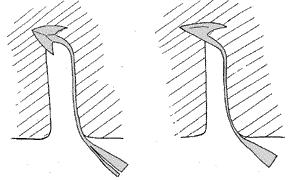 , sometimes causing one flue to catch while the other was positioned with its sharp edge against uncut flesh. The force and the whale's movements could cause the sharp flue to cut through, allowing the harpoon to dislodge. This issue was exacerbated by the large head size across the flue tips, making it difficult to penetrate the blubber deeply enough to hold fast. To address this, one flue was eliminated, reducing the width of the head.
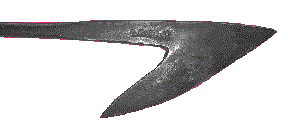 The single-flue iron was developed around the early 1820s, though no specific individual is credited with its invention. Its first recorded use in the American fishery was in 1824. Reuben Delano, in Wanderings and Adventures of Reuben Delano, Being a Narrative of Twelve Years Life in a Whale Ship! (Boston, 1846), described an encounter during his voyage on the Ship Stanton of Fairhaven, from 1824 to 1827. Early in the voyage in 1824, he noted: